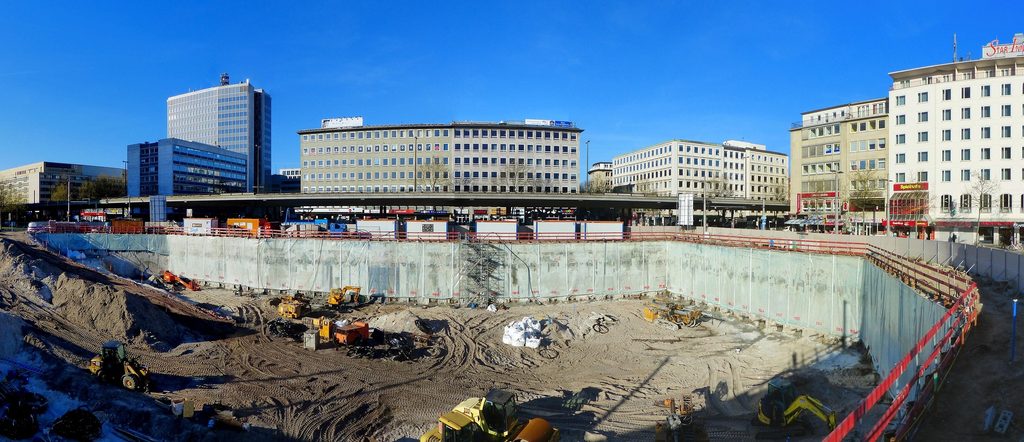
Excavation support systems are what make it possible to open the ground safely in the middle of a working city — holding back soil, rock, and groundwater long enough for a tunnel shaft, station box, or utility corridor to be built without disturbing the streets, foundations, and infrastructure around it.
The right system depends entirely on the ground itself
Every design has to answer the same underlying question — how much ground movement can the surrounding environment tolerate, and how much margin does that leave for the unexpected.
The right system depends entirely on the ground itself: soldier pile and lagging or sheet piling for shallow, temporary excavations; slurry walls and secant pile walls where deep excavations demand a low-permeability, structurally robust barrier; soil nailing and shotcrete for excavations that can tolerate some ground movement; and internally braced or tied-back systems where adjacent structures and utilities leave no room for lateral displacement
That means rigorous lateral earth pressure and groundwater analysis, staged excavation sequencing that keeps the system stable at every step rather than only at completion, and instrumentation that tracks wall deflection and settlement in real time so the design can be verified against actual ground behavior rather than assumption alone
Done well, an excavation support system is invisible in the finished project — but it’s the reason the finished project exists at all.